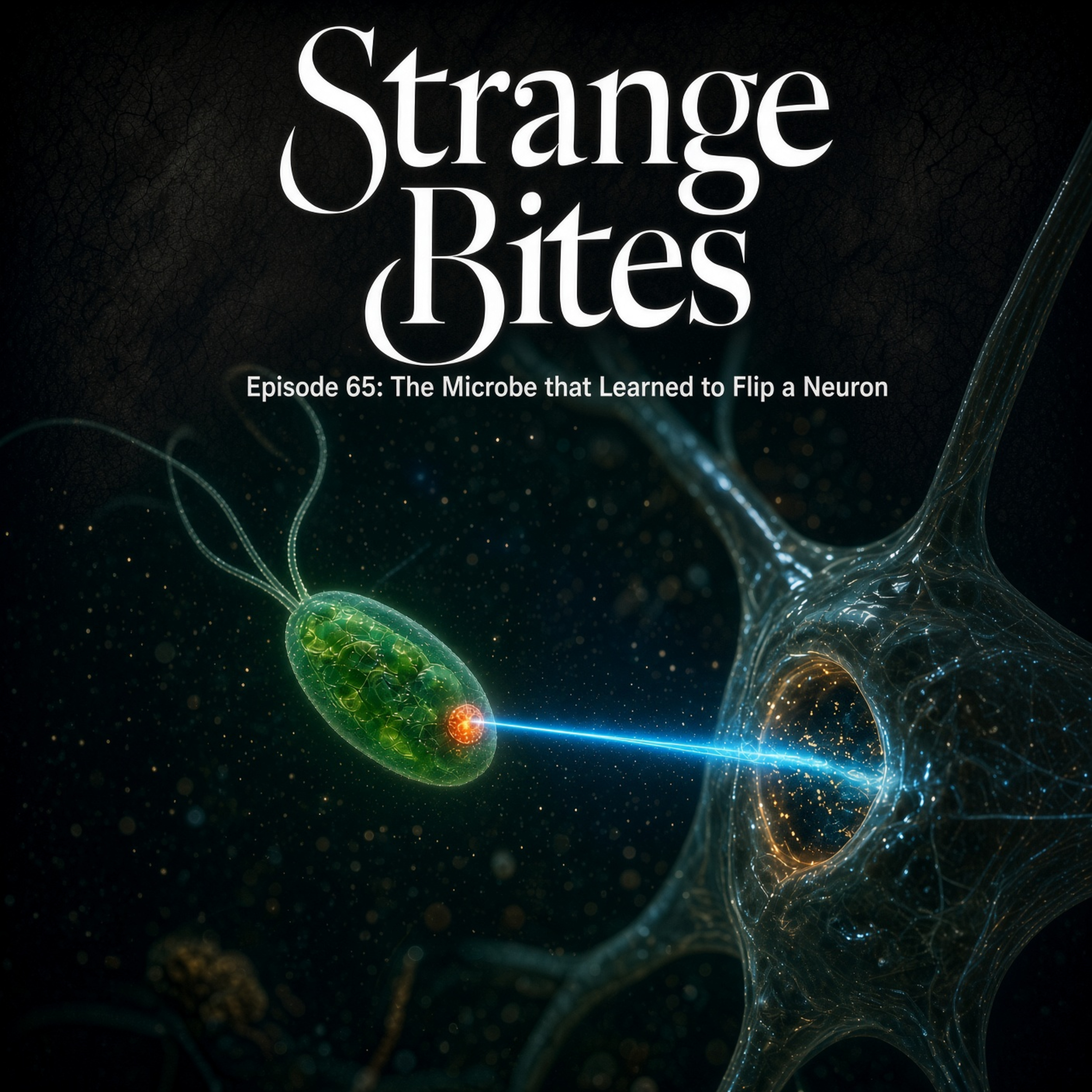
Episode 65: The Microbe that Learned to Flip a Neuron
On October 5, 2026, in Stockholm, the Nobel Assembly at Karolinska Institutet gave the Prize in Physiology or Medicine to three people who never set out to build a remote control for memory. Karl Deisseroth, Peter Hegemann, and Georg Nagel share it “for their discoveries concerning light-gated ion channels and optogenetics.” The prize money is 12 million Swedish kronor, split three ways. The press line is almost too clean: light-seeking algae gave us a switch for nerve cells. Here is the less clean version, which is the better one. This is Episode 65.
Sources
https://www.nobelprize.org/prizes/medicine/2026/press-release/
https://www.nobelprize.org/prizes/medicine/2026/popular-information/
https://www.science.org/content/article/method-controlling-brain-cells-light-wins-nobel
https://www.the-scientist.com/nobel-prize-for-optogenetics-75099
https://www.pnas.org/doi/10.1073/pnas.1936192100
https://www.science.org/doi/10.1126/science.1072068
https://www.nature.com/articles/nn1525
https://www.nature.com/articles/nature11028
https://www.nature.com/articles/s41591-021-01351-4
https://pmc.ncbi.nlm.nih.gov/articles/PMC12860890/
Key papers behind those links: Nagel et al., Science 2002 (channelrhodopsin-1); Nagel et al., PNAS 2003 (channelrhodopsin-2); Boyden, Zhang, Bamberg, Nagel, Deisseroth et al., Nature Neuroscience 2005; Aravanis et al., Journal of Neural Engineering 2007 (living mouse); Liu et al., Nature 2012 (fear engram); Sahel et al., Nature Medicine 2021 (partial vision restoration).
 Apple Podcasts
 Castbox
 Castro
 Goodpods
 Moon FM
 Overcast
 Pocket Casts
 Podbean
 Podcast Addict
 Podcast Republic
 Spotify