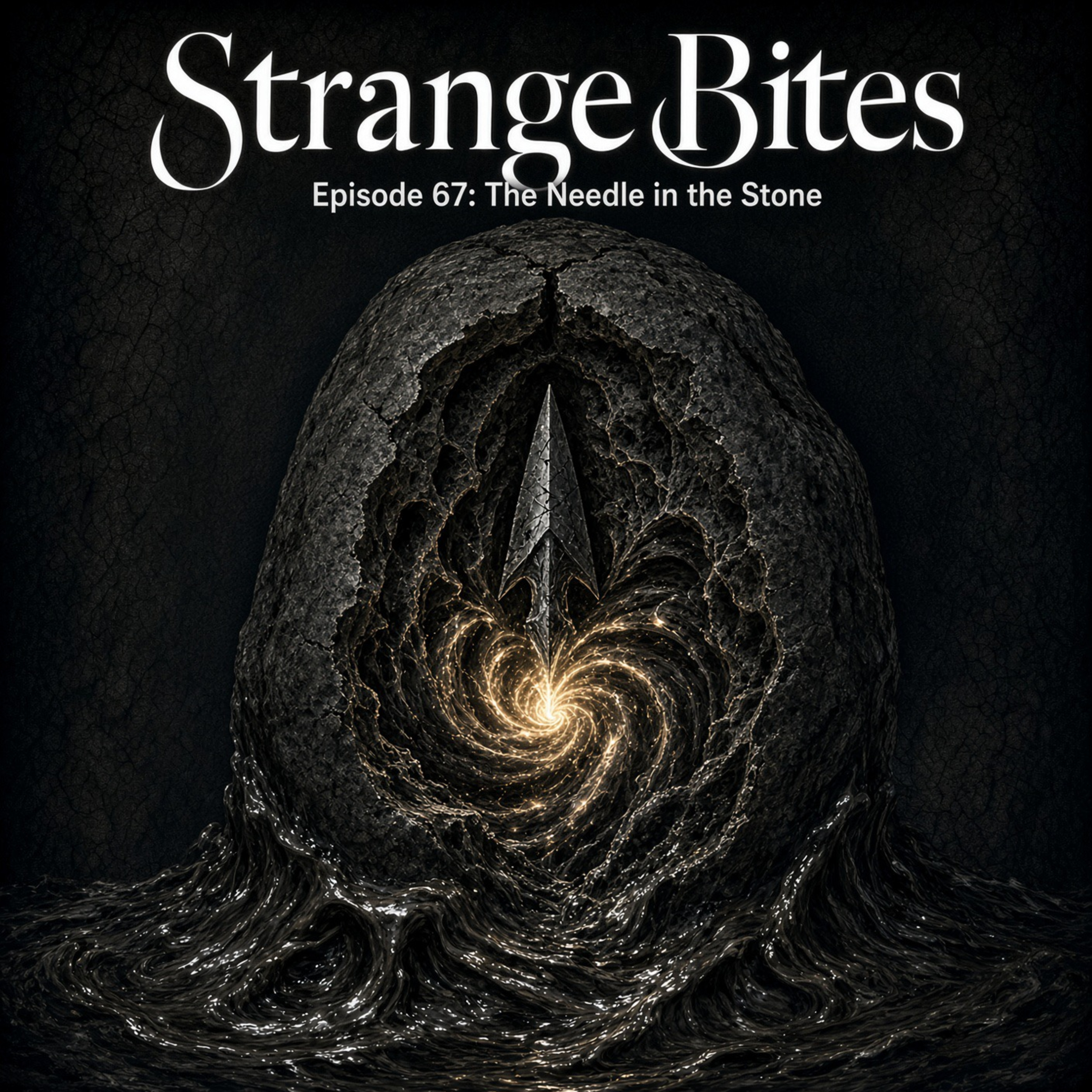
Episode 67: The Needle in the Stone
Somewhere under the Atlantic, in mud that has not seen daylight since the Cretaceous, there is a needle smaller than a speck of dust. It is made of magnetite, the same iron mineral a compass desires, but it is not a compass you could hold. It’s about the size of a bacterial cell and its magnetism is arranged like a tornado around a hollow center. Whatever grew it was reading the planet.
These are magnetofossils. Giant ones, shaped like spearheads, spindles, bullets, and needles, left in seafloor sediment by an animal we still cannot name. A team at the University of Cambridge, working with the Helmholtz Zentrum Berlin, took the first three-dimensional pictures of the magnetism inside one of them and found a structure that looks built to sense both the direction and the strength of Earth’s field. Direction tells you which way is north. Strength, changing from place to place, tells you where you are.
This is Strange Bites episode 67. Tonight we learn about a compass with no owner, and about the oldest evidence we have that an animal was navigating by the planet itself.
SOURCES
https://www.sciencedaily.com/releases/2026/09/260930020329.htm
https://www.eurekalert.org/news-releases/1106425
Paper: Harrison and colleagues. Communications Earth and Environment, 2025. DOI: 10.1038/s43247-025-02721-3
https://www.nature.com/articles/s43247-025-02721-3
 Apple Podcasts
 Castbox
 Castro
 Goodpods
 Moon FM
 Overcast
 Pocket Casts
 Podbean
 Podcast Addict
 Podcast Republic
 Spotify