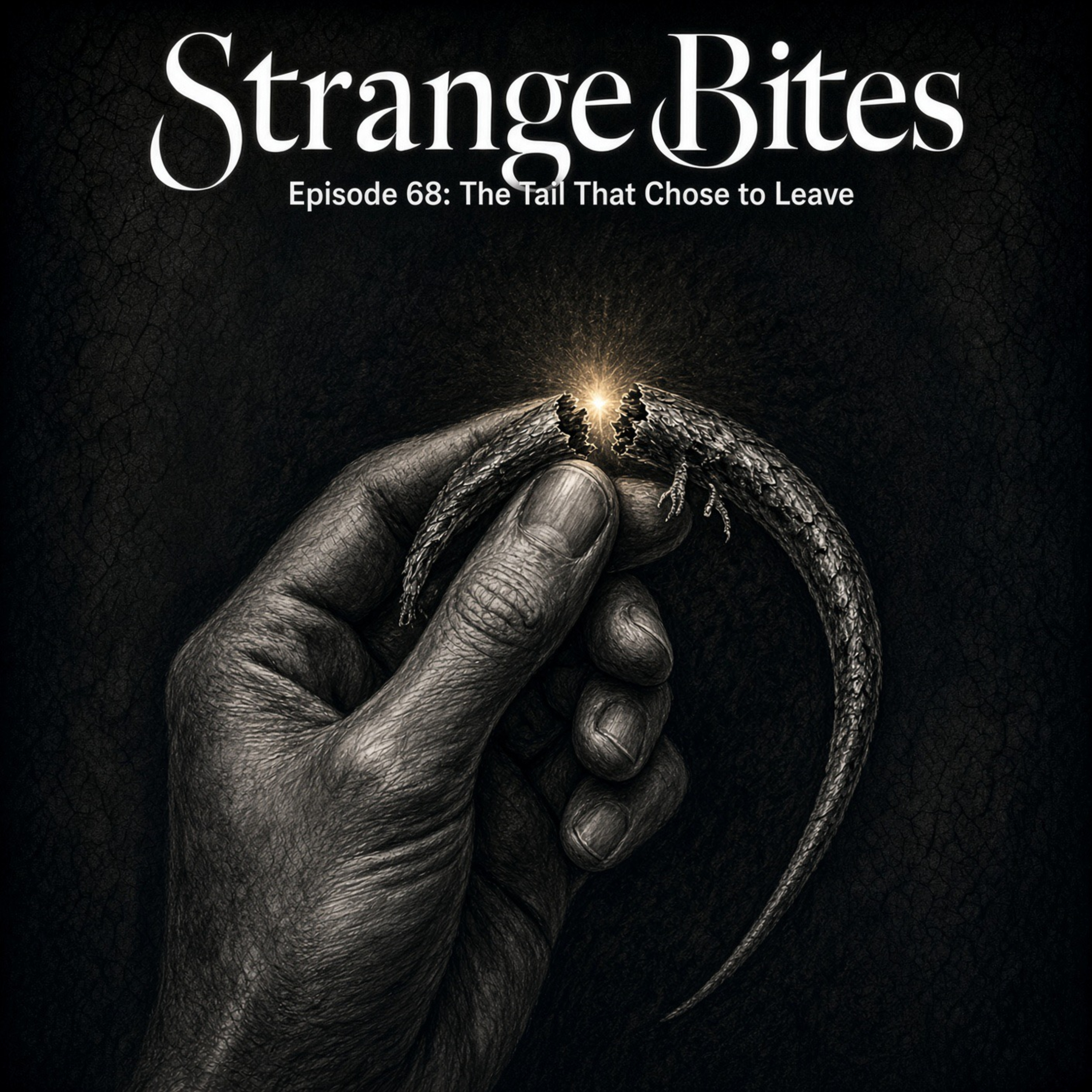
Episode 68: The Tail That Chose to Leave
About ninety-nine million years ago, in a forest that is now northern Myanmar, a small lizard made a decision that is still sitting in a piece of amber. Something came for it. The lizard dropped its tail. The tail did not come off by accident. The break is clean, the muscle ring is still there, and the shape matches what a living lizard does on purpose when it leaves a piece of itself behind.
The specimen is a detached tail, catalogued as SMNHTAU.R.21353, held at the Steinhardt Museum of Natural History in Tel Aviv. It is the first direct fossil evidence of voluntary tail shedding in a vertebrate. Not a broken bone. Not a bite mark. A completed escape, frozen in resin.
Tonight the story is about a defensive trick that was already working in the mid-Cretaceous, and about what amber can keep when stone cannot.
SOURCES
https://www.palaeo-electronica.org/content/2026/5967-first-fossil-evidence-for-a-dropped-lizard-tail
https://doi.org/10.26879/1706
https://www.palaeo-electronica.org/content/2026/5983-first-fossil-evidence-for-a-dropped-lizard-tail-supplemental-materials
Paper: Fabrikant, Christopoulos, Nasser, and Davranoglou. Direct fossil evidence of caudal autotomy in a Cretaceous lizard. Palaeontologia Electronica, 29(3):a38, 2026.
 Apple Podcasts
 Castbox
 Castro
 Goodpods
 Moon FM
 Overcast
 Pocket Casts
 Podbean
 Podcast Addict
 Podcast Republic
 Spotify